
Chainlink has joined a working group with European and South Korean banking organizations to explore the use of stablecoins for foreign exchange (FX) settlement, underscoring how blockchain technology is increasingly being tested to modernize legacy financial infrastructure.
On Tuesday, Chainlink announced Project Pangea alongside South Korean digital asset infrastructure company FairSquareLab, the Unified Korea Alliance (UniKA) — a consortium that includes more than a dozen Korean commercial banks — and Qivalis, a euro stablecoin consortium backed by 37 European banks.
Project Pangea aims to bring together financial institutions across Europe and South Korea to evaluate direct, atomic swaps of euro- and South Korean won-denominated stablecoins using Chainlink’s data infrastructure alongside FairSquareLab’s onchain foreign exchange settlement technology.
The initiative is another example of financial institutions evaluating stablecoins for wholesale financial infrastructure rather than consumer payments. According to the Bank for International Settlements, the global foreign exchange market processes roughly $9.6 trillion in daily trading volume.
Project Pangea is a working group rather than a live payment network, and no production implementation timeline has been announced. The initiative reflects a broader trend of banks experimenting with tokenized deposits and regulated stablecoins to improve cross-border payments and settlement.
Similar initiatives are also emerging. Fintech startup OpenFX recently raised $94 million to expand its stablecoin-based payments network, with an initial focus on Southeast Asia and Latin America.
Related: Brazil bars crypto settlement in regulated cross-border payment rails
Stablecoins gain traction among banks and corporations
Global financial institutions are increasingly exploring stablecoins to improve corporate payments, cross-border settlements and foreign exchange transactions, aided by clearer regulatory frameworks in the United States, Europe and other major financial hubs.
Ripple CEO Brad Garlinghouse recently described stablecoins as having a “ChatGPT moment” as more financial institutions evaluate how the technology could fit into their operations. The trend helps explain why Citigroup projects the global stablecoin market will grow to $1.9 trillion by 2030, up from roughly $315 billion today.
According to Citigroup, that expansion will be driven by continued adoption within crypto markets, a gradual shift from physical US dollar banknotes to digital dollars and the growing use of stablecoins as a store of short-term liquidity in both US dollars and local currencies.
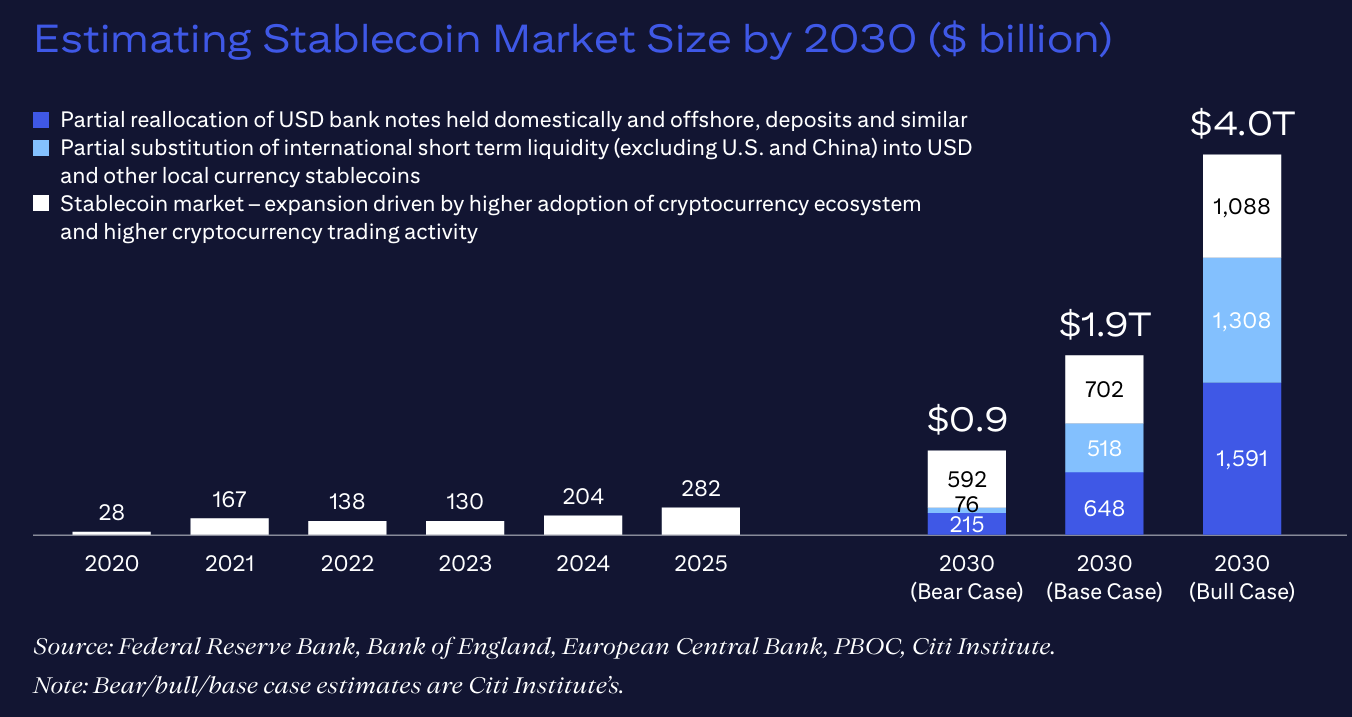
Citigroup estimates the stablecoin market could grow to as much as $4 trillion by 2030 in its most optimistic forecast. Source: Citigroup
Related: Malta proposes DeFi rulebook covering DAOs under MiCA-era framework
Cointelegraph is committed to independent, transparent journalism. This news article is produced in accordance with Cointelegraph’s Editorial Policy and aims to provide accurate and timely information. Readers are encouraged to verify information independently.