In brief
- Perplexity released a research preview of a post-trained GLM 5.2 version, built to act as an orchestrator inside its Computer harness and escalate to Claude Opus 4.8 only when needed.
- The system costs one-third the price of Opus 4.8 across benchmarks.
- It's Perplexity's second Chinese open-source fine-tune in 18 months—the first being R1-1776, a version of DeepSeek R1 stripped of roughly 300 Beijing-mandated censorship topics.
Perplexity has turned a Chinese open-source model into a near-frontier workhorse at roughly a third of what Claude Opus 4.8 costs.
The company released a research preview today of a post-trained version of Z.AI’s GLM 5.2, built specifically to operate inside its Computer agent harness and available now in production.
We're releasing a research preview of a new orchestrator model in Perplexity Computer.
The model is an adapted version of GLM 5.2, post-trained for the Computer harness. It delivers near-frontier performance at 0.344x of the cost of Opus. pic.twitter.com/jcxikoFRfn
— Perplexity (@perplexity_ai) July 9, 2026
GLM 5.2 is a roughly 744-billion-parameter model from Z.ai—formerly Zhipu AI, a Beijing lab that's been on the U.S. Entity List since January 2025. (Parameters are all the different dials and configurations a model can handle during training. The more parameters, the more complex and powerful a model s.) Released under an MIT license in June, it sits among the top AI models currently available on long-horizon coding benchmarks at a fraction of the API cost.
The open weights mean anyone can download, modify, and fine-tune it commercially without restrictions. Perplexity did exactly that.
What fine-tuning actually is
Fine-tuning is the process of taking an already-trained AI model and retraining it on a smaller, focused dataset to make it better at a specific job.
Think of it like tuning a car. Different mechanics can have the same Honda Civic, for example, and make it faster for drag racing, more visually pleasing, adapt it for rally, etc. In AI, developers get a base model and add different settings so the finetune ends up with more knowledge on a specific field, a different political bias, more or less restrictions, etc.
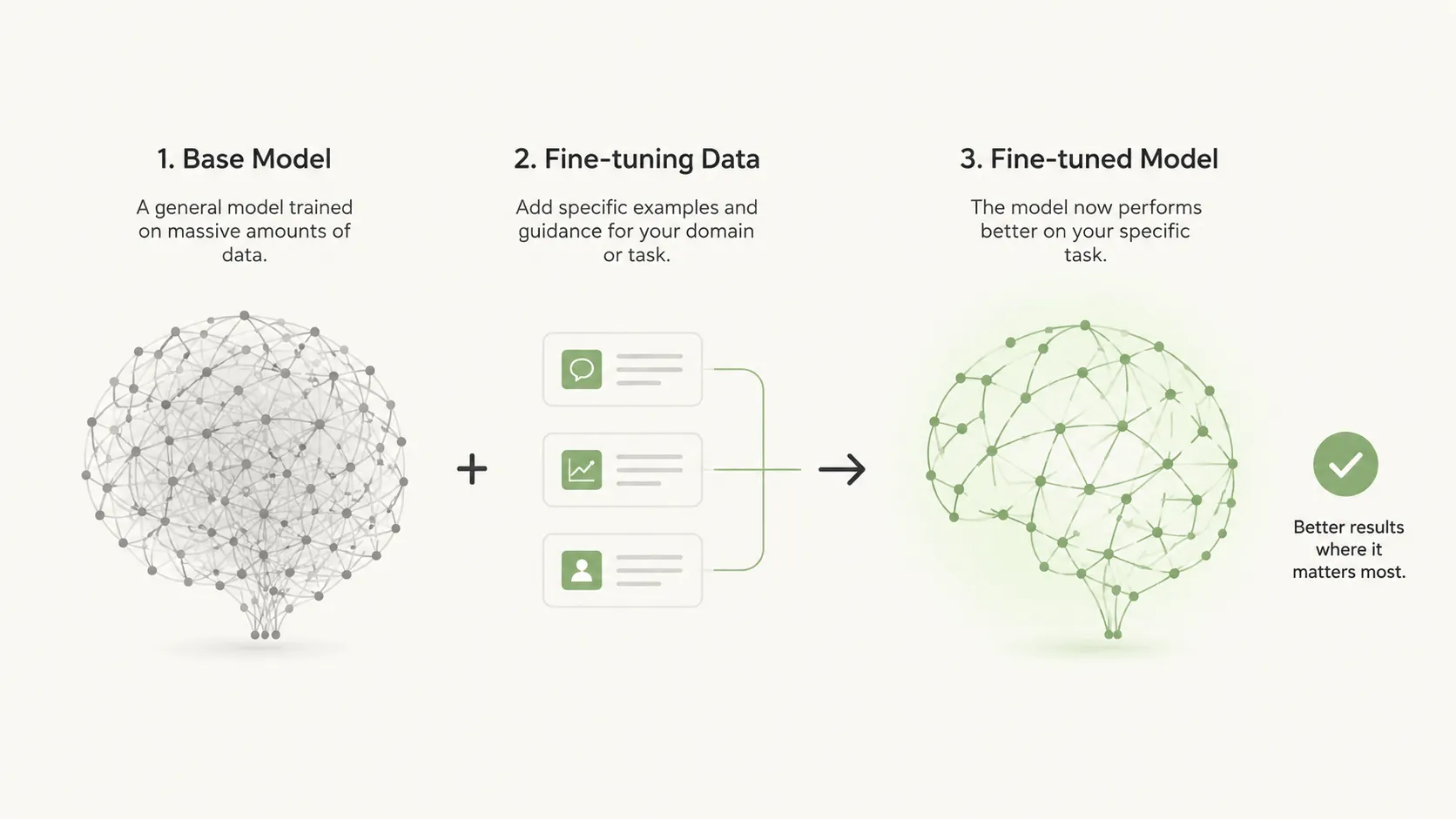
Perplexity used post-training—a similar process applied after the model's main training run—to teach GLM 5.2 one critical skill: knowing when to handle a task itself and when to escalate to something more powerful.
That escalation is the core of what they built. The fine-tuned GLM 5.2 includes what Perplexity calls an "advisor tool"—a native capability to recognize when a query exceeds its own competence and hand off to a third-party frontier model. Most tasks never reach the expensive model. Only the ones that actually need it do.
This ends up saving a lot of money in inference.
"When paired with an advisor, this model functions at Opus 4.8 grade performance at a fraction of the cost," CEO Aravind Srinivas wrote on X.
We’ve been post-training a version of GLM that is trained to escalate to a frontier model inside the Computer harness. When paired with an advisor, this model functions at Opus 4.8 grade performance at a fraction of the cost. Available now as a research preview! https://t.co/7y8CjOWOtI
— Aravind Srinivas (@AravSrinivas) July 9, 2026
Perplexity benchmarked the system against the normal GLM 5.2 to establish a cost baseline. Using the company's internal efficiency metric which measures how much it costs to complete complex tasks, the results showed that the fine-tuned model with an advisor is about twice as expensive to run as the basic version. However, using the top-tier Opus 4.8 model for everything is much more expensive (around 600% pricier).
By combining these tools, Perplexity’s system achieve the same quality performance as Opus but only at roughly one-third the price
Why a Chinese model—and why open-source makes it possible
The U.S.-China AI race tends to be framed as zero-sum. In practice, open-source models don't stop at borders. GLM 5.2's MIT license makes the calculus simple: There's no API contract to violate, no access switch a government can flip. You download the weights and you can fine-tune them into whatever you need.
Perplexity has been down this road before. When DeepSeek R1 swept through the AI world in early 2025, the company fine-tuned it into R1-1776—mapping roughly 300 topics the original refused to discuss due to Chinese government censorship, and retraining the model to make it more biased in favor of the United States. It became a Western-hosted version of the same reasoning engine.
"We are not able to make use of R1's powerful reasoning capabilities without first mitigating its bias and censorship," Perplexity's team wrote at the time in a blog post.
So, this GLM 5.2 move follows the same template, except the goal this time isn't political but economic. Perplexity's Computer product already orchestrates 19+ AI models; the fine-tuned GLM is designed to be the cheap default that absorbs the bulk of tasks before ever touching a frontier model.
Srinivas said the long-term thesis is straightforward: post-train open-source models to get good at escalation, inside an agent harness that already serves millions of users. Perplexity is "uniquely positioned" to solve it, he wrote, because the infrastructure is already deployed at scale.
The model runs on Nvidia B200 GPUs in the United States. Next in line: a post-train of Nemotron 3 Ultra, which would replicate the same architecture using an American open-source model.
Full benchmarks and a research paper are expected in the coming weeks. The model is available as research preview.
Daily Debrief Newsletter
Start every day with the top news stories right now, plus original features, a podcast, videos and more.