Ready, a self-custodial crypto wallet and payments company, has reportedly restricted card access for users outside the European Economic Area, according to multiple user reports.
Ready has restricted USDC card functionality for users outside the European Economic Area following a change in its card provider, according to notices shared by users on social media.
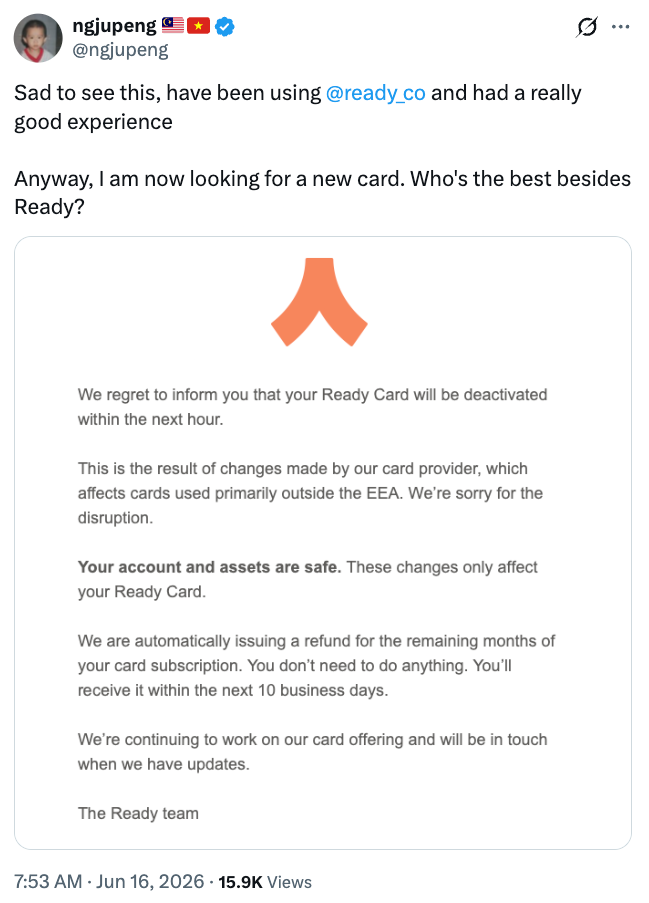
Several users shared screenshots of an in-app notice from Ready stating: “Your Ready Card will be deactivated within the next hour,” citing changes affecting users “primarily outside the EEA.”
The reported changes left some users questioning how quickly access to crypto-linked payment cards can be restricted when providers change.
Users question speed of restriction and communication
Several users criticized the short notice period before the changes took effect, saying they lost access to the card within hours.
One user, who uses the X handle TapSatoshi, said in a post that they were frustrated with the company’s product roadmap, citing delayed features such as Apple Pay support and prioritizing the addition of a “Rewards” section.
Source: ngjupeng
Screenshots of Ready’s message also stated that users would receive automatic refunds for any remaining subscription period within 10 business days.
It remains unclear which company will serve as the new card provider for the Ready Card or what prompted the change. The previous issuer-side partner linked to the program was Kulipa, according to publicly available documentation.
Related: BitGo courts crypto firms awaiting MiCA approval amid Binance licensing concerns
Cointelegraph contacted Ready for comment regarding the issue but did not receive a response by publication time.
USDC at the center of the Ready Card
Formerly known as Argent, Ready is a wallet built for the Starknet ecosystem, an Ethereum layer-2 scaling network using zero-knowledge rollups.
While Ready’s wallet supports multiple crypto assets, including Bitcoin (BTC) and Ether (ETH), the Ready Card is primarily built around USDC, which users spend directly from their wallet balance at checkout.

Source: Ready
According to Ready documentation, the system checks a user’s USDC balance in real time when a purchase is made and processes the transaction through Mastercard’s payment network, converting crypto into fiat at the point of sale. The card issuer acts as the bridge between the self-custodial wallet and traditional payment rails.
This structure allows users to retain full control of their assets in the wallet, while the card only provides a spending layer on top of those funds. If card access is restricted, users can still hold and transfer USDC onchain without interruption.
Magazine: The end of anon? AI could unmask crypto’s hidden identities
Cointelegraph is committed to independent, transparent journalism. This news article is produced in accordance with Cointelegraph’s Editorial Policy and aims to provide accurate and timely information. Readers are encouraged to verify information independently.