Jul 9, 2026, 6:40 a.m.
3 min read

Summary
- A cat-themed memecoin called CASHCAT has become the first breakout hit on Robinhood’s new Arbitrum-based blockchain, soaring to a market value of about $105 million.
- Early buyers have turned tiny stakes into seven-figure windfalls, with the five most profitable wallets realizing roughly $3.7 million in gains, even as thousands of later traders provide the exit liquidity.
- Despite the frenzy, CASHCAT trades on thin liquidity and sharp price swings, highlighting the risks of speculative memecoins and complicating Robinhood’s push to position its chain as infrastructure for tokenized real-world assets.
Major financial exchange Robinhood launched its own blockchain on July 1 to move stocks and bonds onchain. But the first breakout hit is a cat-themed token that's generated a fortune for early, lucky punters.
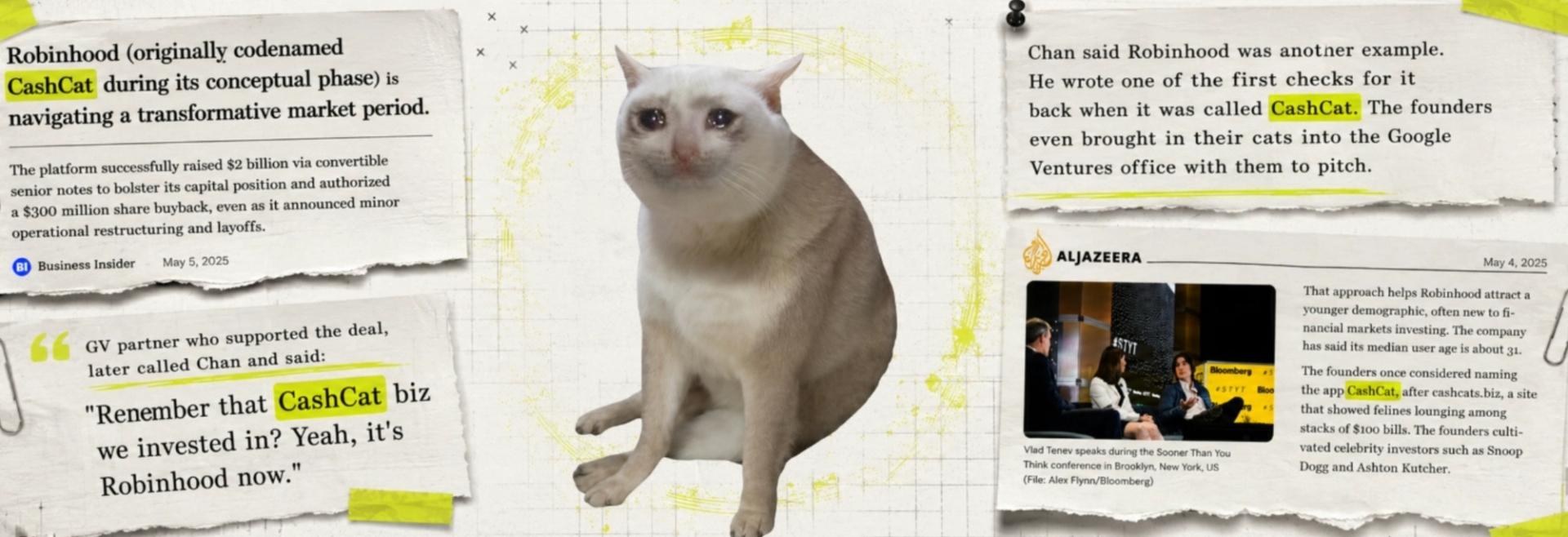
CASHCAT, a memecoin named after the mascot Robinhood used before it was Robinhood, has surged several hundred percent on Robinhood Chain in the past two days, the Arbitrum-based network the brokerage switched on at a London keynote billed "Robinhood Presents: The World Is Flat."
One early buyer spent $838 on 15.04 million tokens roughly three weeks ago and has since sold about 13.5 million of them for around $917,600, according to onchain data, with the remainder worth roughly $133,700 as of Asian afternoon hours Thursday. That is a return of about 1,250 times the original stake.
It is not alone. A second wallet turned $85 into 17.4 million tokens in one buy and has realized about $687,700 while sitting on roughly $1.2 million more on paper.
The five most profitable wallets have banked close to $3.7 million between them, DEXScreener data shows. Every dollar of it came from someone on the other side of roughly 12,300 sell orders.
The whole thing stands on shaky ground, however. CASHCAT carries a market value of about $105 million against roughly $6.6 million of liquidity in its Uniswap pool, meaning it may not absorb even a fraction of the holders trying to leave at once.
The token is down about 12% over 24 hours and roughly a quarter off the intraday peak near $145 million it touched on Wednesday, and sell volume has edged past buy volume, $29.1 million against $28.9 million, across more than 30,000 transactions from about 6,800 traders.

Robinhood did not create the token. CASHCAT's own website describes it as "fan fiction with a ticker," a project built by outsiders around the cat-with-cash logo the company used in its earliest days before rebranding. The utility, the site says, "is cat."
Interestingly, on July 2, the day after the chain went live, Robinhood's chief executive Vlad Tenev told CNBC that memecoins were largely a dead end, as 'assets without utility do not serve a lasting purpose,' and that tokenized real-world assets were the durable direction for crypto.
However, days later on July 7, as CASHCAT climbed, he posted on X that while the company is building its chain to be the best for real-world assets, "it works great for memes too." He also followed the token's account.
While we’re building robinhood chain to be the best chain for RWA … it works great for memes too
— Vlad Tenev (@vladtenev) July 8, 2026
Meanwhile, Pump.fun, the Solana launchpad that created a boom in extremely short-term memecoin trading, announced on July 8 that it had added support for Robinhood Chain tokens, letting users trade them without bridging.
"It's only right that the leading app in trading edge supports everything that traders want to speculate on," co-founder Alon Cohen wrote on X.
While the trade is the kind of story that draws people in, it does not fully show the buyers who bought after a token had already gained several hundred percent in a day, or the ones still holding as it retraces.
A token whose market value swung by tens of millions of dollars within hours can take that value back on the same timescale, causing steep losses for traders who buy at the top.
The memecoin frenzy is a mixed result for Robinhood.
A new blockchain needs transactions and wallets to look alive, and speculative trading delivers both faster than tokenized Treasuries do. The company has spent months positioning the chain as infrastructure for tokenized equities, with day-one integrations from decentralized exchange Uniswap and oracle service Chainlink.
What arrived first was a cat with a fistful of cash, and a chief executive who spent a week arguing that this was precisely the thing crypto needed to outgrow.
- 1
- 2
- 3
- 4
- 5
- 6
- 7
- 8
- 9
- 10