
A group of law enforcement organizations and a coalition of Catholic organizations have become the latest two groups urging caution over the US CLARITY Act, which is heading for a key hearing in July.
In letters sent Tuesday, four law enforcement organizations reached out to White House officials with concerns that the CLARITY Act could create oversight gaps when it comes to illicit activity.
“Regulatory certainty should not come at the expense of accountability, transparency, victim protection, or public safety,” they said. The Alliance to End Human Trafficking, founded by US Catholic Sisters, said these oversights could make it harder to crack down on human trafficking.
The CLARITY Act, which is set for a House hearing on July 17, aims to establish a regulatory framework for digital assets but has garnered a number of critics. It cleared the Senate Banking Committee in May, with most Democrats voting against it, while the banking industry has also pushed back, arguing the bill would allow crypto firms to offer stablecoin yields without facing the same requirements as traditional financial institutions.
The law enforcement group includes the National District Attorneys Association, the National Association of Assistant United States Attorneys, the International Association of Chiefs of Police and the National Sheriffs’ Association.
In the letter addressed to Acting Attorney General Todd Blanche and White House digital assets adviser Patrick Witt, the group said it was concerned with the Blockchain Regulatory Certainty Act, or Section 604 of the legislation, which it claims would create oversight gaps, hinder illicit-activity probes and weaken know-your-customer and anti-money-laundering requirements compared with traditional finance.
Section 604 of the market structure bill addresses the regulatory framework for digital asset service providers and seeks to protect noncontrolling developers, open-source contributors, self-custody tools and certain DeFi infrastructure from being automatically classified as money transmitters.
The letter said there was no concern with individuals who write or publish software code or with responsible technological innovation, but with exemptions on crypto transactions that may affect law enforcement’s ability to investigate.
“Our concern is with broad exemptions that may shield individuals or entities whose activities facilitate the movement of digital assets, create obstacles to legitimate oversight, or weaken longstanding investigative and enforcement authorities relied upon by law enforcement.”
However, Lindsay Fraser, chief policy officer at the Blockchain Association, said the letter showed a “fundamental misunderstanding” of the CLARITY Act.
“Section 604 does one narrow thing,” she said. “It prevents non-custodial software developers from being misclassified as money transmitters when they do not custody assets or control transactions.”
“It does not immunize criminals. It does not limit sanctions enforcement. It does not stop prosecutions for money laundering, fraud, or terrorist financing.”
Anti-trafficking advocates push back
Meanwhile, the Alliance to End Human Trafficking sent a similar letter Tuesday to Senate Republican Leader John Thune and Senate Democratic Leader Chuck Schumer, also flagging Section 604 but from a human rights abuse perspective.
Related: Crypto isn't the problem with the US economy, says senator
Certain provisions under Section 604 could create “broad carveouts and regulatory ambiguities” that may make it “more difficult to responsibly monitor illicit financial activity tied to trafficking, organized crime, child exploitation, sanctions evasion and other forms of abuse,” it said.
“The test of any financial system is not simply whether it generates wealth or innovation, but whether it safeguards human life and dignity.”
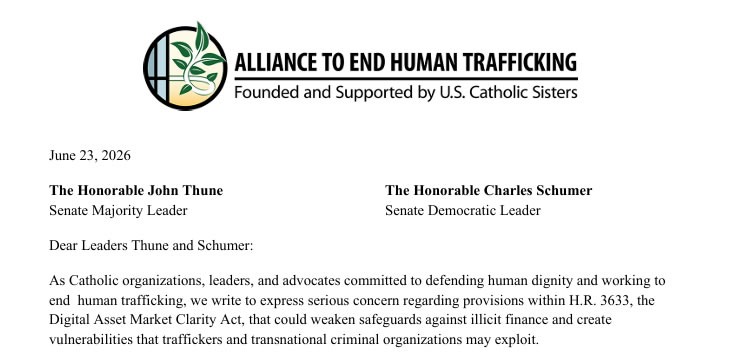
Screenshot of June 23 AEHT letter. Source: Punchbowl News
CLARITY Act proponent Senator Cynthia Lummis took the opposite view, stating Thursday that “Regulatory ambiguity doesn’t just hurt builders. It helps criminals… The CLARITY Act closes the gaps bad actors exploit.”
“The CLARITY Act is clear: writing code is not money transmission. That distinction will matter for a generation of builders,” she added on Tuesday.
Magazine: Japanese pension fund tips 1% in crypto, G7 urges action on NK hackers: Asia Express
Cointelegraph is committed to independent, transparent journalism. This news article is produced in accordance with Cointelegraph’s Editorial Policy and aims to provide accurate and timely information. Readers are encouraged to verify information independently.