Jul 10, 2026, 9:26 p.m.
4 min read

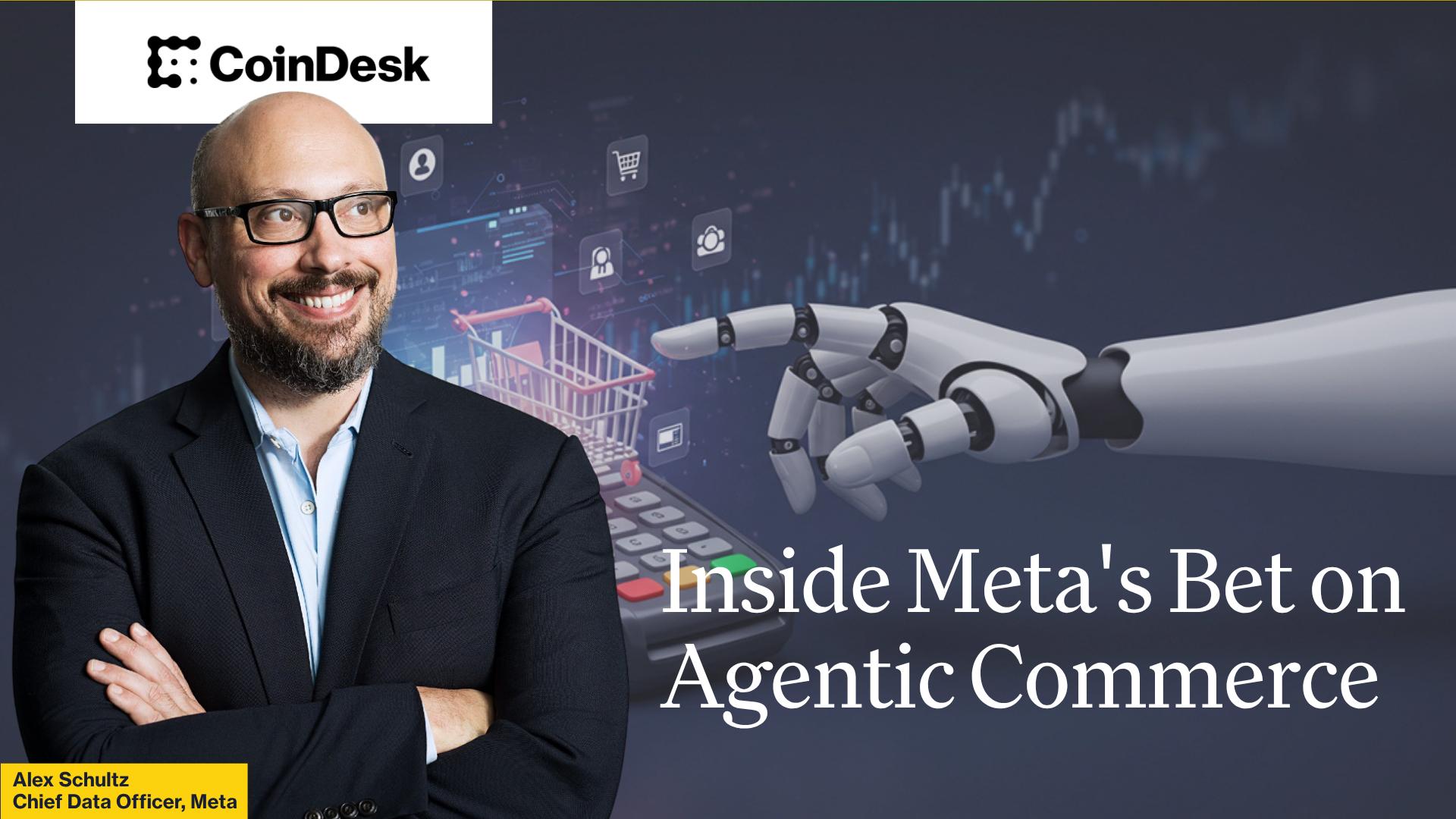
In a wide-ranging conversation on CoinDesk Spotlight, Schultz laid out a view of Meta's future in which agentic commerce is not a product category but an inevitability.
"We think it might be the next tier of business for our entire company," he told host, Sam Ewen.
The Agentic Economy Is Already Here, But It’s Unevenly Distributed
Schultz framed the agentic economy the same way science fiction author William Gibson framed the future: already present, not yet mainstream.
"We are building business agents for all businesses," he said. "We have over a million weekly active businesses with Meta agents[...] from basically nothing at the start of the year."
The use case he outlined was deliberately mundane: coordinating a child's birthday party. Agents booking times, checking calendars, finding venues, communicating with other parents' agents, all on WhatsApp. The point of the mundane example is that it scales. If agents can handle low-stakes logistics, they can handle supply chain negotiations, financial settlements, and cross-border commerce.
"You write that example large," Schultz said, "and then if you're us, you hope that you do it over WhatsApp"
The payments layer inside that vision is stablecoins.
Schultz sees physical wallets as obsolete, predicting "We completely believe in the future of there being no wallets and digital payments being the whole future," he said, pointing to WeChat's red envelope model and Line's commerce infrastructure in Japan, Thailand and Taiwan as proof that conversational commerce at scale is not theoretical. "Stablecoins are a big part of the solution."
Both WeChat and Line have been at the forefront of digital peer to peer payments and in-app commerce throughout Asia.
He added that he thinks the United States’ reliance on iMessage is "very backwards." In Brazil and India Schultz said Meta has more than a million small businesses doing commerce in conversation on WhatsApp.
"iMessage is such a lame platform in terms of its usage and what you can do with it," he said. While American consumers tap to pay in stores, conversational commerce has become the standard in Asia. It creates a direct path and connection between consumers and merchants, often supercharged by trusted creators and influencers. Fortune Business Insights predicts it will grow to $39.53 billion by 2034, largely driven by AI.
Meta, Libra, and the Road Back to Digital Payments
The conversation happened on the seventh anniversary of Facebook's Libra announcement. A moment Schultz acknowledged with a dry aside: "Maybe we said some stuff that annoyed some governments."
But Schultz's framing of what comes next for Meta in financial services is partnership, not proprietary currency. "The history of the company is that we tend to be a partnership company on these things."
Meta's play is to be the interface layer, the messaging and commerce surface, while payment settlement moves underneath it.
That strategy also reflects how dramatically the regulatory landscape has changed since Libra. Meta's attempt to launch its own global stablecoin triggered scrutiny from Congress and U.S. regulators, who raised concerns about financial stability, privacy, and the company's potential influence over the global payments system. The project was eventually rebranded as Diem before being abandoned in 2022 under sustained regulatory pressure. Today, with stablecoin legislation in place and the SEC taking a more accommodating stance toward the crypto industry, Meta appears to be pursuing a less controversial strategy: integrating regulated third-party stablecoins into its platforms rather than issuing one itself.
On Decentralization: "My God, It Would Be Useful"
Schultz's most candid moments came when asked about decentralization and proof-of-humanity systems.
"Decentralization, especially if we can take verification outside of our system — my God, it would be useful for us," he said. "It would just be incredible if there was a decentralized service that we could just plug into."
He said Meta hasn’t done it yet because no system has the scale, reliability, or mainstream penetration to warrant going all-in. "Really smart people have tried, and it's not there yet,."
But the demand is there. Schultz wrote a post on the agentic economy which included a pointed observation: "For you to transact with an agent, you need to know it represents the business it says it represents." That verification layer is the core challenge for an agentic economy to function. If decentralized identity can solve it at scale, Schultz made clear Meta would use it.
Whether the pieces come together on Schultz's timeline remains to be seen. But inside Meta, agentic payments, decentralized identity and stablecoin rails are no longer treated as distant possibilities. They are treated as realities.
- 1
- 2
- 3
- 4
- 5
- 6
- 7
- 8
- 9
- 10
Digital Assets: Quarterly Review and Outlook Q2

Digital Assets: Quarterly Review and Outlook Q2
Digital assets posted a third consecutive quarter of losses in Q2 2026, the longest losing streak since the 2022 bear market, as institutional capital rotated into AI equities and Bitcoin ETFs recorded their largest quarterly outflow since launch. Our report examines what drove the divergence, where structural adoption continued regardless, and what Q3 signals to watch.
12 hours ago
Digital assets posted a third consecutive quarter of losses in Q2 2026, the longest losing streak since the 2022 bear market, as institutional capital rotated into AI equities and Bitcoin ETFs recorded their largest quarterly outflow since launch. Our report examines what drove the divergence, where structural adoption continued regardless, and what Q3 signals to watch.
Why it matters:
Digital assets posted a third consecutive quarter of losses in Q2 2026, the longest losing streak since the 2022 bear market, as institutional capital rotated into AI equities and Bitcoin ETFs recorded their largest quarterly outflow since launch. Our report examines what drove the divergence, where structural adoption continued regardless, and what Q3 signals to watch.