Aug 6, 2026, 11:37 a.m.
3 min read

Summary
This is an excerpt from CoinDesk newsletter 'Daybook.' Sign up here, if you haven't already.
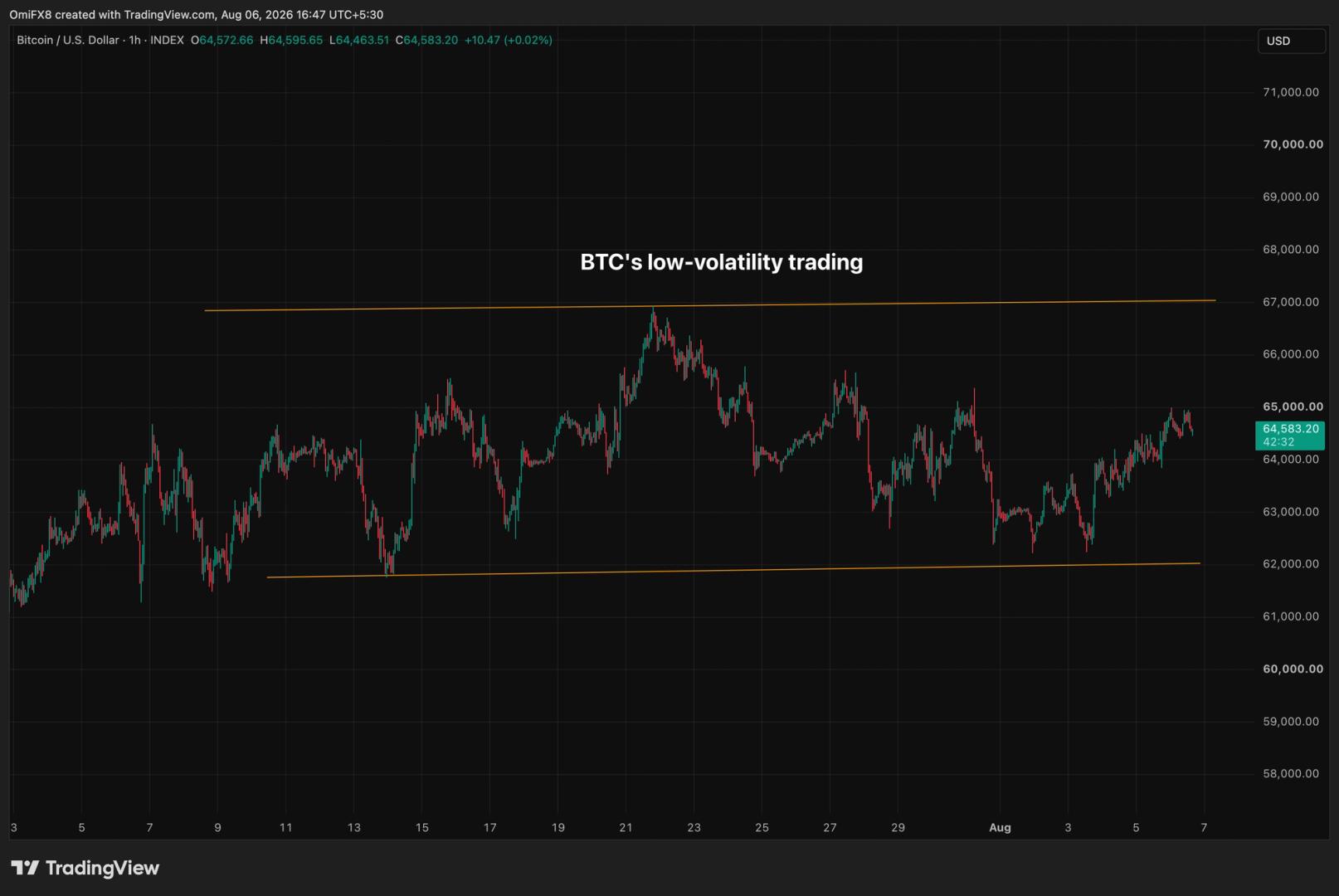
A key theme this month is not just that bitcoin BTC$64,558.75 isn’t taking part in the risk-on rally exemplified by stocks, it’s how steady the cryptocurrency has been, to the point that 30-day implied volatility has dropped to a long-held floor of 36%.
More often than not, low volatility is taken as a sign of low risk. After all, if an asset isn’t swinging wildly, it must be safer, more predictable than one that is gyrating rapidly. In recent weeks, BTC has looked far steadier than South Korea’s Kospi index, for example.
But that only tells us what is, not what could be. In other words, low volatility is no reason to let your guard down. When volatility is cheap, trading becomes cheap, encouraging punters to build large directional bets and hedging positions. That leaves the other side, the market makers, with a lot of exposure too.
If the market then starts moving, both sides end up doing more and more position management, adding to price swings. This explains why volatility is said to increase, or revert toward the mean, after a period of persistent decline.
“When volatility is cheap, traders can build directional positions and hedges at relatively low cost. If the market then moves through a level with concentrated positioning, dealer hedging can accelerate the move,” Adam Haeems, head of asset management at Tesseract Group, which manages $500 million in client assets, said in an email.
“The practical implication is that low volatility should not be mistaken for low risk. It is a reason to be careful with leverage, particularly when trading volumes and market depth are subdued.”
For now, BTC remains choppy below $65,000 with some green shoots.
According to Paul Howard, a senior director at market-making firm Wincent, demand for puts, or downside protection, has weakened. At the same time, there is a lack of strong bids for upside exposure.
“It indicates that the bear market is close to trading at its lowest price range for this cycle, arguably over the coming weeks,” he said in an email.
“The asymmetry is not a bid for puts; it is the disappearance of the call bid. Nobody is paying for upside, and nobody is paying much for downside,” Glassnode said.
According to Howard, the next big catalyst would be “some positive regulatory news such as with the Clarity Act, which would likely manifest as institutional ETF inflows.”
A negative catalyst, meanwhile, could be a potential breakdown in the Hormuz talks and an inflation shock. Stay alert!
Read more: For analysis of today's activity in altcoins and derivatives, see Crypto Markets Today . For a comprehensive list of events this week, see CoinDesk's "Crypto Week Ahead."
What’s trending
- Here are the possible outcomes for Clarity right now (CoinDesk): The fate of the crypto market-structure legislation is precarious, with only two days before the Senate goes on recess. Senators have not indicated whether they will work on the Clarity Act or vote on the bill.
- Bitcoin steadies above $64,000 as traders watch $100 billion SpaceX unlock (CoinDesk): Bitcoin held above $64,600 while the rest of the major coins offered little by way of direction. Attention is on SpaceX, where roughly $101 billion of stock becomes tradable as the first lockup expires.
- Yen and dollar drift as markets await Iran deal news, look towards payrolls (Reuters): Currency markets drifted, with the yen retracing some intervention-led gains and the dollar pinned near a six-week low as investors awaited details on a proposed U.S.-Iran deal and looked ahead to Friday's U.S. jobs report.
- World shares are mixed and Kospi falls 4.6% after tech giants decline on Wall Street (AP): Shares were mixed in Europe and Asia, with and South Korea’s Kospi index dropping more than 4%. Oil prices held steady, with uncertainty about the Iran war overhanging markets despite hopes for a reopening of the Strait of Hormuz.
Today’s signal

The chart compares bitcoin’s price swings with dogecoin DOGE$0.06915, the largest meme token by market value.
Since early July, DOGE has remained under pressure, decoupling from the recovery in BTC’s price.
The divergence shows that speculative interest remains absent, and traders are not chasing high-beta, meme-driven exposure even as bitcoin stabilizes. This is usually the first sign of a market bottom.
Related Assets
- 1
- 2
- 3
- 4
- 5
- 6
- 7
- 8
- 9
- 10
The Evolution of the Crypto CEX Landscape: A Case Study on Binance

The Evolution of the Crypto CEX Landscape: A Case Study on Binance
Binance remains crypto’s leading exchange, expanding from spot and derivatives into RWAs, payments, savings, yield, and broader financial services.
Jun 29, 2026
Binance remains crypto’s leading exchange, expanding from spot and derivatives into RWAs, payments, savings, yield, and broader financial services.
Why it matters:
Binance remains crypto’s leading exchange, expanding from spot and derivatives into RWAs, payments, savings, yield, and broader financial services.