Aug 6, 2026, 10:43 a.m.
5 min read

Summary
- Bitcoin is outperforming the broader crypto market as traders rotate toward large-cap tokens like bitcoin and ether while altcoins see falling open interest and weak momentum.
- Derivatives data show a cautiously bullish tilt for bitcoin, with rising futures open interest, steady implied volatility and growing upside options bets, while XRP and SOL face leverage-driven pressure.
- NEAR’s new stake-to-compute model ties its token to AI computing power, but analysts say its success hinges on sustained real demand and usage once early incentives and subsidies fade.
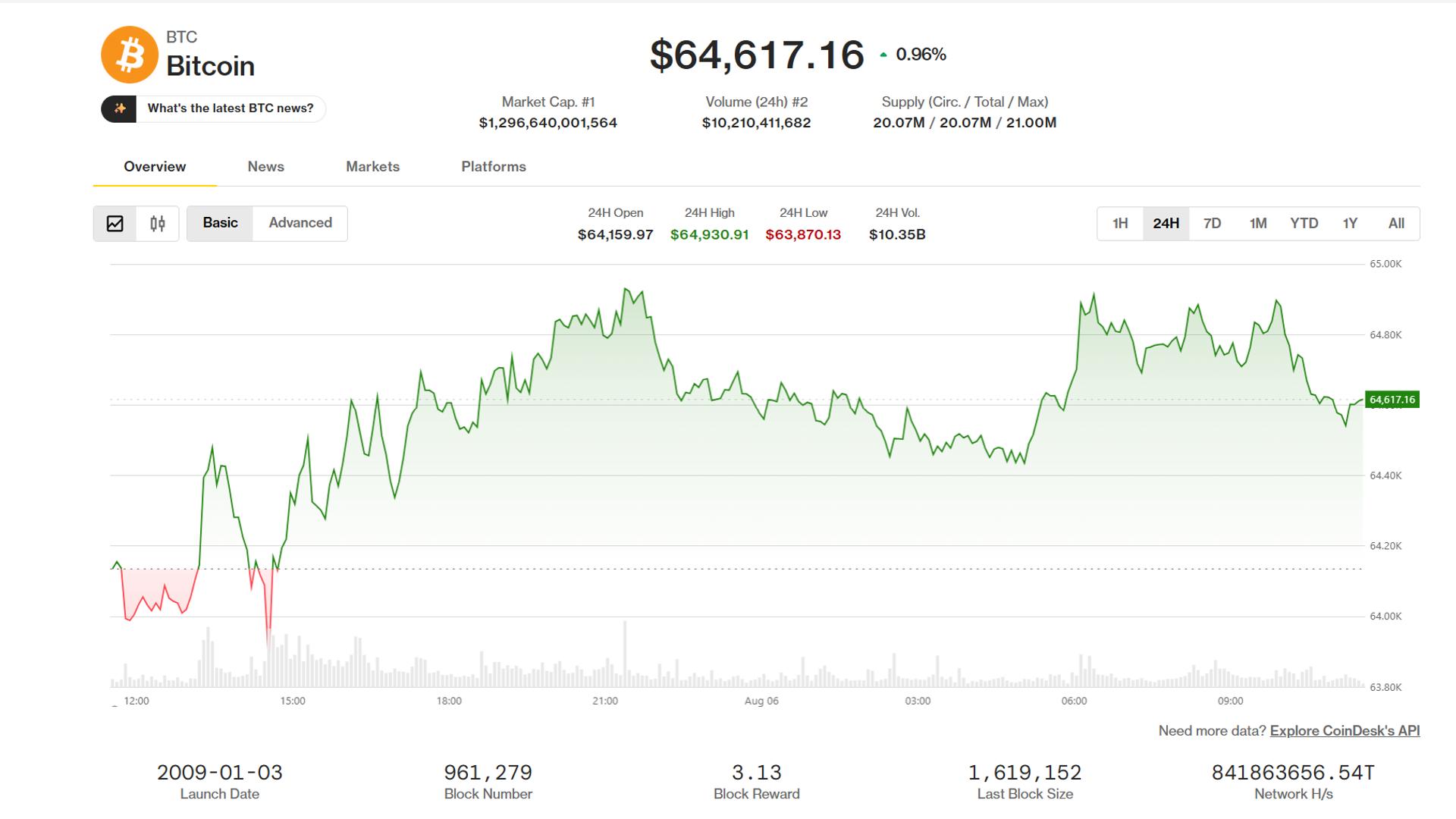
Bitcoin BTC$64,597.62 has added around 0.9% in the past 24 hours to $64,700, while the broader CoinDesk 20 (CD20) is up just 0.16%. Strength in equity markets, which have climbed to record highs, appears to leave the crypto sector unperturbed.
Crypto appears to be moving to the perceived safety of the biggest tokens, with bitcoin and ether ETH$1,903.32 the only CD20 members in positive territory. Zaheer Ebtikar, the chief strategy officer at crypto neobank Plasma, told CoinDesk altcoins are struggling “without aggressive support from bitcoin momentum.”
Altcoin open interest has fallen about 15% over the past month while bitcoin has gained roughly 8%, Ebtikar said. CoinMarketCap’s Altcoin Season index fell one point from Wednesday to 42/100.
“Because Bitcoin has moved into capital markets plumbing with ETFs, basis trading, institutional hedging, and collateral, that flow doesn't need a rally to justify itself. However, most of the altcoin market hasn't made that transition yet,” Ebtikar said.
The divergence, according to Ebtikar, results from projects failing to clearly define how value accrues, making them unable to justify investors’ exposure to their tokens during market declines.
Adding to that, tech stocks are seeing weakness. Nasdaq 100 index fell while the S&P 500 and Dow Jones Industrial Average rose. That’s after Elon Musk’s SpaceX (SPCX) reported its first results since going public in June.
The IPO unveiled a massive surge in AI-linked capital spending that investors punished, bringing shares down 13% before the closing bell. The AI trade has been widely blamed for capital rotating out of the crypto sector. Its reversal could help renew enthusiasm.
Derivatives Positioning
- Starting with the good news: The long-short taker volume ratio for the crypto futures market flipped bullish for the first time in at least a week, with longs accounting for nearly 52%. Takers are traders who suck liquidity out of the order book by transacting at available prices.
- BTC open interest ticks up, but sustainability remains the question: BTC's futures open interest (OI) increased to 770K BTC. We've been here before several times since early June, but each time the spike was brief, with OI falling back to 740K BTC or lower the following day. What's needed is a sustained rise to show that confidence is being restored and investors are once again willing to on leverage. Other key metrics, such as annualized perp funding rates and 24-hour OI-adjusted cumulative volume delta (CVD), are positive for BTC, supporting a bullish outlook.
- XRP's rising OI alongside falling price: XRP's OI has increased by 5% over the past 24 hours to 2.23 billion tokens while the token's price has dropped to $1.04, the lowest since early July. The combination of a falling price and rising OI is said to confirm, or validate, market weakness. This logic seems reasonable given that XRP's perp funding rates are negative, and its OI-adjusted CVD is among the most negative of the majors, second only to XLM. Some traders, it seems, are preparing for a deeper spot price slide.
- ETH stays lackluster, SOL leverage unwinds: Ether's OI tally remains lackluster, staying below the 14 million ETH mark and showing neither improvement nor position downsizing. That’s in contrast to SOL futures, where OI fell for another day to 60.81 million tokens, having peaked above 76.5 million tokens on June 24.
- Stock-tied perps rank among the most traded contracts: Some of the most traded perpetual futures contracts of the past 24 hours are those tied to stocks, such as SNK, SPCX and SKYHYNIX. These rank up there with crypto market leaders BTC and ETH, indicating persistent demand for trading legacy assets with a crypto flavor.
- Majors show mixed sentiment on 24-hour CVD: Major cryptocurrencies are displaying mixed sentiment, with BTC and ETH leading the pack on positive 24-hour CVD, while SUI, XLM, DOGE, AVAX and XRP sit on the other side. Positive CVD indicates that bulls are being more aggressive, trading at market orders rather than passive limit orders; negative CVD suggests the opposite.
- Implied volatility holds steady for BTC and ETH: Bitcoin implied volatility is unchanged from Wednesday, with the BVIV index continuing to hover near 36%, a level from which it has historically risen toward its mean. The same holds true for the ether index, EVIV.
- Options flow shows growing activity in upside bets: In Deribit options, bitcoin’s 24-hour volume ranking shows increased interest in calls, or bullish bets, at strikes well above the current spot price, such as the $96,000 and $80,000 calls. For ether, the $2,000 call is the most traded of the past 24 hours.
Token Talk
- NEAR traded at $1.68 on Thursday, down 1.8% over 24 hours after slipping from an intraday high of $1.73. The token carries a $2.19 billion market cap, and its price hasn't tracked the ecosystem's AI-compute push higher.
- NEAR's move into AI-compute staking has a demand question looming. The network recently started a staking product that lets holders lock up NEAR to provision the computing power AI applications run on, tying the token's use to compute power rather than governance or speculation. The model only works if the demand behind it is real, said Leo Fan, CEO of Cysic.
- Credits aren't the same as usage. Stake-to-compute setups can give a token a clearer economic purpose, Fan said, but early activity is often driven by incentives, with developers showing up for rewards rather than because they need the compute. The test is whether that usage survives once the incentives normalize.
- Watch three things, Fan said. Utilization, meaning how much of the staked compute is actually being used, workload volume and whether developers keep paying after the subsidies taper. Sustained demand from AI builders will prove the model out. A drop-off when rewards fade would mark it as temporary.
- The read applies beyond NEAR. Tying a token to compute is one of the cleaner attempts to move crypto past governance-and-speculation utility, but it lives or dies on whether the compute gets used. NEAR is the test case others in the AI-crypto space will be watching.
Related Assets
- 1
- 2
- 3
- 4
- 5
- 6
- 7
- 8
- 9
- 10
The Evolution of the Crypto CEX Landscape: A Case Study on Binance

The Evolution of the Crypto CEX Landscape: A Case Study on Binance
Binance remains crypto’s leading exchange, expanding from spot and derivatives into RWAs, payments, savings, yield, and broader financial services.
Jun 29, 2026
Binance remains crypto’s leading exchange, expanding from spot and derivatives into RWAs, payments, savings, yield, and broader financial services.
Why it matters:
Binance remains crypto’s leading exchange, expanding from spot and derivatives into RWAs, payments, savings, yield, and broader financial services.